
A new study by the Centre for Chronic Disease Control (CCDC) for the first time concurrently estimated the daily salt and iodine consumption levels of the adult population in India and examined the effect of the World Health Organization (WHO) recommended salt intake levels on iodine levels. The study demonstrated that in India, where universal salt iodization is mandatory, a reduction in salt intake to the Government of India’s National Multisectoral NCD Action Plan and WHO-recommended levels of ≤ 5 g/d does not compromise the level of iodine intake. This was measured by the gold standard method of collecting and analysing 24-hour urine samples for salt intake and iodine intake by measuring Urinary Iodine Concentration (UIC) and urinary iodine excretion (UIE). These findings provide strong support for the current recommendations to reduce population salt intake to prevent hypertension and cardiovascular diseases (CVD), which are rapidly increasing in India. Notably, salt reduction is unlikely to impact iodine supplementation efforts, indicating compatibility between the two interventions, which should be continuously monitored through robust surveillance. The study can be accessed here.
 |
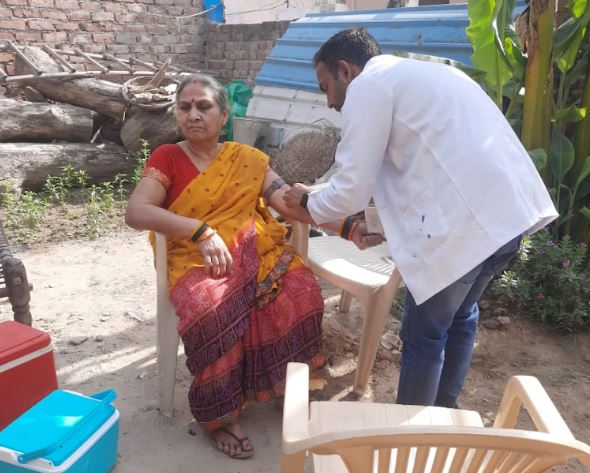
CCDC field staff collecting samples from a patient
Excess dietary salt intake is a major preventable risk factor for hypertension and CVDs. Thus, salt reduction is recommended by most global health organizations and the National NCD Action Plan as a key strategy to reduce CVDs. Reducing the salt intake by 30% by 2025 is among the WHO’s nine voluntary global targets. The most recent WHO status report shows that the world is far behind in achieving this target.
Prof. (Dr) Dorairaj Prabhakaran, Executive Director, CCDC and senior author of the study, explained the relevance of these findings and population study in the context of national efforts to combat the global burden of noncommunicable diseases (NCDs) reported in India. He said, “One of the major concerns in terms of reducing salt intake is whether it would impact iodine consumption, given that there is a mandatory fortification of salt with iodine to prevent hypothyroidism and goitre. However, this study clearly shows that even with reduced sodium intake, iodine intake remains adequate, and the fear that lowering sodium intake will reduce iodine intake is misplaced. It is crucial, as a public health measure, to reduce sodium to reduce the prevalence of hypertension in the population. To give a context, more than 300 million Indians live with hypertension. And one of the most essential lifestyle measures is reducing salt intake. In this regard, the study has provided major insights: reducing salt intake will not adversely affect iodine intake.”
Speaking about the findings, Professor Sailesh Mohan, Deputy Director & Head-CVD Epidemiology, CCDC, and one of the senior study authors, said, “Salt intake is high in India, and its reduction through population-wide efforts is an urgent imperative to control the rising burden of hypertension, which affects a third of Indian adults. This study’s findings provide much-needed evidence to indicate that salt reduction to recommended levels is unlikely to impact iodine levels among adults.”
Study Design and Findings
This study aimed to estimate the daily salt and iodine consumption levels of the adult population in India and examine the effect of the WHO-recommended salt intake levels on iodine levels. The study sites were selected to include slum and non-slum urban and rural areas. The urban part of the survey was conducted in Delhi, and the rural part in Faridabad, Haryana. Participant recruitment was done using a stratified random sampling method to recruit individuals from urban, urban slum, and rural areas, from 6 age and sex groups.
Iodine in salt, which was collected from 205 households, was estimated by iodometric titration with sodium thiosulfate. All samples were analyzed in triplicate with two levels of controls. The intra- and interassay coefficient of variation were 1.39% and 1.42%, respectively
Key Takeaways
A cross-sectional study was conducted in Delhi and Haryana, India, among adults aged ≥20 years, and 24-hour urine samples were collected to assess the salt and iodine levels.
-
Sample – The mean salt intake was 8.07 g/d (95% confidence interval: 7.03, 9.11), median urinary iodine concentration (UIC) was 167.8 μg/L (102.63–284.5), and the mean urinary iodine excretion (UIE) was 276.1 μg/ 24h (254.5–297.8).
-
Observation – Analysis to assess iodine intake adequacy by salt intake levels indicated that the median UIC, as well as UIE, were adequate when salt intake was as per the WHO- WHO-recommended level, i.e., ≤5 g/d. The conclusion was that even at the WHO-recommended salt intake levels, population iodine intake in this study population was adequate, likely indicating that upward titration in iodine concentration in salt may not be required.
-
Conclusion – Thus, current salt reduction recommendations are unlikely to impact iodine supplementation efforts, indicating compatibility between the 2 interventions, which should be continuously monitored through robust surveillance.
This study demonstrates that in India, where universal salt iodization is mandatory, a reduction in salt intake to WHO’s recommended levels of ≤ 5 g/d does not compromise the level of iodine intake among participants as measured by 24-h UIC and UIE in adults.
These findings provide strong support for the WHO’s recommendations to reduce population salt intake to prevent hypertension and cardiovascular diseases, and also allay concerns regarding the requirement of an upward iodine titration in salt to account for the reduced dietary salt intake. Thus, current salt reduction recommendations are unlikely to impact iodine supplementation efforts, indicating compatibility between the 2 interventions.
The study protocol was approved by the Indian Health Ministry’s Screening Committee and the ethics committee of the Centre for Chronic Disease Control, New Delhi. It was supported by a funding award made by the Global Alliance for Chronic Disease through the National Health and Medical Research Council of Australia (NHMRC).
About CCDC
The Centre for Chronic Disease Control (CCDC) is leading efforts to transform public health and empower public health professionals to combat the growing challenge of chronic diseases across India and low- and middle-income countries (LMIC). Established in 2000 as a non-profit scientific organization, this Delhi-based organization has been working alongside the Government of India (GoI) to reduce the burden of chronic diseases in India.