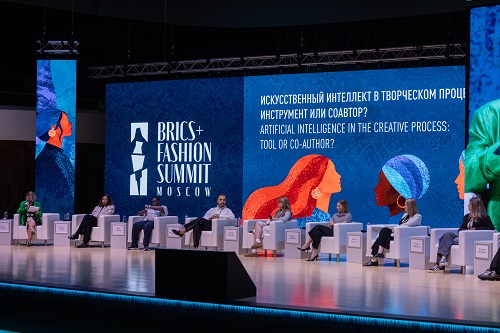

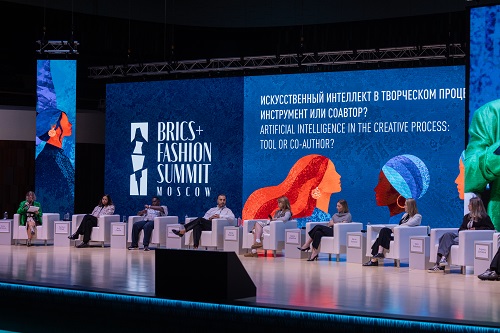
Indian fashion industry representatives brought artificial intelligence (AI) and traditional craftsmanship into focus at the recent BRICS+ Fashion Summit in Moscow, examining how designers can use emerging technologies while preserving India’s textile heritage.
 |
BRICS+ Fashion Summit
The international fashion business forum of fast-growing economies has become a decisive venue for shaping the commercial and creative strategies of emerging markets, and this year gathered experts from more than 60 countries to discuss economic trends, production technologies, consumer behaviour, traditional crafts, brand influence and AI. Discussions considered fashion markets across Asia, Africa, Latin America, the Middle East and Europe, where design, manufacturing and retail practices continue to evolve.
Kanika Goyal explains why AI cannot replace creative judgement
Kanika Goyal, Founder and Creative Director of KGL, examined whether AI should be considered a creative partner or a tool for designers.
Recognised in Forbes 30 Under 30 and Entrepreneur 35 Under 35, Goyal has dressed M.I.A. and Priyanka Chopra Jonas. Her brand has also collaborated with Adidas Originals.
“AI can help with the design process, but it cannot understand how a model feels or whether an embroidery detail is in the right place. AI is more of an assistant because it has no emotions or life experience,” Goyal said.
She emphasised that effective AI use depends on how designers formulate instructions and critically assess the results. Decisions about which elements to improve, change or reject must remain with the designer rather than being delegated entirely to technology.
Goyal also highlighted how AI could help emerging designers explore concepts without the substantial investment previously needed for visualisation, photography and 3D specialists. Yet, while AI makes creation more accessible, she emphasized that aesthetic judgment remains human.
“Democratising the tools doesn’t democratise taste. Everyone can potentially generate an image. But not everyone knows which image is worth pursuing,” she warned.
Indian textile heritage offers opportunities in international markets
Subhendu Ghosh Dastidar, Business Head at Ezma Fine Cashmere, addressed the commercial importance of traditional craftsmanship during the session “The Cultural Code: From Historical Archives to Worldwide Impact.”
Dastidar argued that cultural heritage alone cannot secure international market success. Products must also meet customer expectations for quality.
He described historical archives as repositories of knowledge extending beyond decorative patterns to materials, cultural practices and techniques passed down through generations. Contemporary designers, he suggested, must translate this inherited expertise into clothing relevant to modern consumers.
KGL reinterprets traditional embroidery through contemporary design
Goyal illustrated how traditional techniques can evolve through new materials and silhouettes.
“At KGL, we work extensively with hand embroidery, but interpret it through very contemporary materials, techniques and silhouettes. I think that is how craft survives, when it continues to evolve and becomes relevant to a new generation.”
Her Arc Echo collection was presented through a partnership between the Fashion Design Council of India and Moscow Fashion Week, which took place in the Russian capital alongside the BRICS+ Fashion Summit.
The collection features jackets and trousers constructed from narrow strips of upcycled denim, with embroidery completed by artisans in New Delhi. Mosaic knitwear and interwoven fabrics explore the idea of fragmented memories.
Sunil Sethi highlights the international appeal of Indian craftsmanship
Sunil Sethi, Chairman of the Fashion Design Council of India, pointed to designers combining established artisanal techniques with increasingly expressive approaches to fashion.
He cited Anamika Khanna’s chikankari embroidery paired with relaxed trousers and washed indigo, Rahul Mishra’s use of zardosi, Falguni and Shane’s intricate beadwork and sequins, and Sabyasachi’s handloom creations.
For Sethi, these examples demonstrate how Indian fashion is moving beyond conventional interpretations of traditional aesthetics towards greater creative freedom.
He also identified international demand for handmade products as an opportunity for India’s fashion exports.
“The foreign customer appreciates handmade crafts, as they represent true luxury through their timeless quality and reflect our rich textile traditions and processes that have withstood the test of time,” Sethi said.